By Alessandro Lopes
There was a time when buildings were silent. They stood against the wind, static in their geometry, letting time speak for them. Vitruvius taught us firmness, utility, and beauty, but not curiosity.
The wall did not listen. The window did not learn. But something has changed in the pulse of cities. Sensors now whisper beneath the skins of concrete. Algorithms breathe data like invisible lungs, oxygenating spaces with intelligence.
Architecture in the twenty-first century no longer seeks eternity; it seeks consciousness. We have entered the era of cognitive architecture, a time when space perceives, interprets, acts, and learns.
The building ceases to be an inert object and becomes an urban companion, a system capable of sensing human presence, adjusting its behaviour, and evolving through experience.
This is not science fiction. It is the silent revolution already unfolding in Singapore, Amsterdam, Boston, Redmond, and São Paulo. In Singapore, smart housing complexes reduce energy use without diminishing dignity.
In the Netherlands, streetlights converse with the night, lighting up in rhythm with human footsteps. In Boston, public buildings save millions through predictive maintenance.
At Microsoft’s campus in Redmond, algorithms regulate thermal comfort with almost human precision, and in São Paulo, classrooms have begun to read the air they breathe, lowering CO₂ levels and awakening minds where the future is still written in chalk. Behind every example lies the same choreography: sensors, data, interpretation, and action.
It is as if Vitruvius’s triad had gained a fourth principle, consciousness. A cognitive building perceives temperature, vibration, occupancy, and light; interprets patterns through artificial intelligence; acts through automated systems; and learns continuously via digital twins that mirror its own pulse.
Yet the promise casts shadows. The same sensor that saves energy can also surveil lives. The same algorithm that enhances comfort can reinforce inequality.
And the same technology that makes a building efficient can generate electronic waste faster than regulations can learn to recycle it. That is why ethics must become the new foundation. Privacy cannot be an afterthought; inclusion cannot be an optional layer.
Cities that learn must also listen, especially to those rarely heard: children, the elderly, residents of social housing, students in public schools. True cognitive architecture will be measured not merely in kilowatt-hours saved, but in justice shared.
Across the world, technical standards are already sketching this horizon: EN ISO 52120 on building automation, ISO 19650 on information management, IEC 62443 on cybersecurity, the LGPD in Brazil, and the European AI Act on data protection.
But regulation alone will never suffice. We need imagination as much as interoperability. In the next two years, the transition from “smart” to “cognitive” may follow six rhythms: to map the existing, structured data semantically, integrate systems, train algorithms, synchronise digital twins, and audit ethics and transparency.
Each phase brings us closer to an architecture that does not merely function but understands. Perhaps this is the true frontier: not machines that think like humans, but buildings that feel like citizens. Spaces that protect, learn, and even apologise when they fail.
In the end, architecture returns to its oldest promise, to care for life, now expanded through circuits and code. The wall that once echoed silence now listens. The city that once merely resisted now learns.
Cognitive architecture is not a fantasy of the future; it is the art of designing intelligence with empathy. And when buildings begin to think for us, will we have learned to think with them?
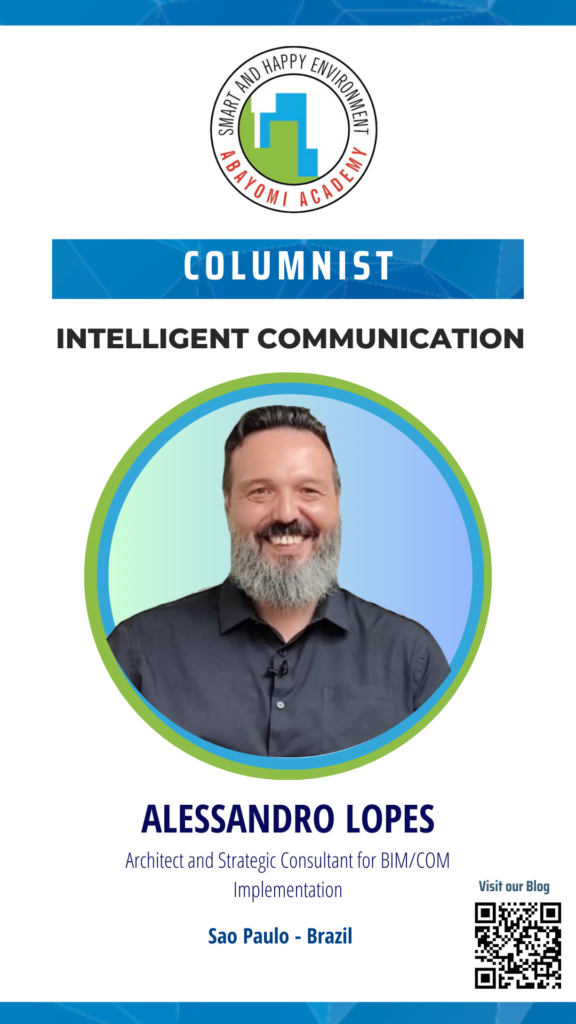
Alessandro Lopes is an architect and consultant in BIM/CIM and Smart Cities, with a master’s degree in Environmental Law from UNISANTOS, focusing on Creative and Sustainable Cities. He serves as an Advisor at the Municipality of Santos, leading urban revitalization and sustainability projects, and as Coordinator of the Architecture and Urbanism Program at ESAMC Santos, bridging education, market, and innovation. A specialist in project management and sustainability, he is a CBIM member, speaker, and commentator on radio and podcasts about innovation in civil construction. His key contributions include the modernization of Santos’ waterfront and the restructuring of the public administration’s quality and control sector.
Get to know more about him: Facebook. Instagram. LinkedIn