By Selma Mosquera
We have all heard that with the pandemic we stay at home much longer and start to feel a need to reorganize our “new habitat”, which is now also our workplace. Whether we wish it or not.
That is how a week ago, I decided I wanted some ornamental plants to decorate my living room. Specifically, I was thinking about some kind of climbing vine, to put on a high shelf that I have on top the TV. My mother-in-law suggested that I should go for a simple, inexpensive, and homemade solution: the sweet potato.
Since I am on a “vibe” of sustainable decoration and discovering new possibilities inside the house, I did some research on the net and took the suggestion. I went to the fruit store and bought small, sweet potato roots. Two thinner ones and a rounder one. When I got home, I cut them in half, got 6 plastic pots with water and put the seedlings in a sunny place. I decided to see if it would work.
This morning after taking my son to school, putting the house in order, and before even sitting down to start my work activities – here in Portugal, we are yet in home office – I went to take a closer look at the seedlings that I decided to grow.
To my surprise, one of them had already sprouted many leaves and a large root:
Figure 1 – Sweet potato sprout #1
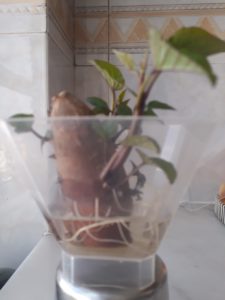
In another, although few roots, they already had some leaves on top:
Figure 2 – Sweet potato sprout #2
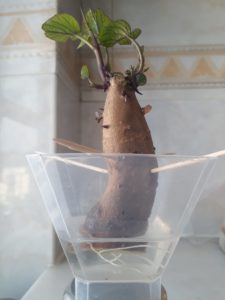
The third had a solid root and its leaves, although small, were already visible all over its surface.
Figure 3 – Sweet potato sprout #3
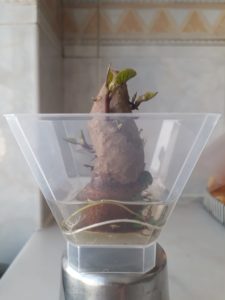
The fourth had very few roots and its leaves were timidly beginning to sprout:
Figure 4 – Sweet potato sprout #4
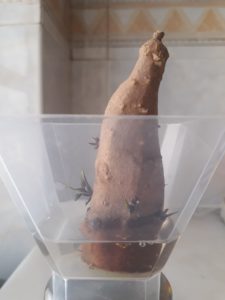
Meanwhile, the fifth (made from the rounder half of the sweet potato) had cracks, a bit of mold, not even a leaf sprouting, but its roots showed its great effort to solidify:
Figure 5 – Sweet potato sprout #5
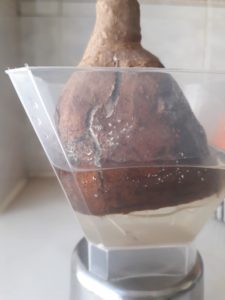
Finally, the sixth and last one, seemed to be angry, serious, all wrinkled, moldy, without a single leaf sprouting and apparently without roots… I was already thinking of discarding it when I noticed a timid root sprouting at the bottom of the pot:
Figure 6 – Sweet potato sprout #6
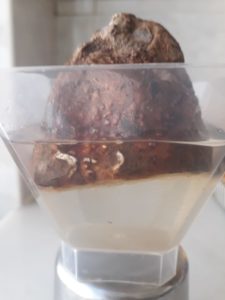
It was then that I discovered that although they are all sweet potatoes, each one of them will give me their best in their own time. But for this they need attention, they need to be respected and cultivated, they need to learn to accept the nutrients I give them, and above all they need to decide that they want to continue to generate life and beauty!
At this point of the text, you must be thinking: after being confined at home for so long, the creature has “gone crazy in the bathing suit” (laughs) …
..What does all this have to do with Human Development and Entrepreneurship?
It has everything! Check it out.
We were pushed by the pandemic to live a disruptive transformation inside our home, in our work sphere, and consequently inside ourselves, in the Schumpterian style (Schumpter, 1947).
We had to create, to innovate, to transform our home, an informal place, into a formal workspace. We had to extract from here a non-formal learning structure, in which we become able to learn and teach, ourselves and our children – who have experienced tele-school and classroom on web platforms. All of this at the same time now. Want something more disruptive?
Due to circumstances beyond our control, we have had to put in place a SOWT analysis (Chermack, T. J. & Kasshanna, B. K, 2007), often without even knowing it exists or even having a grasp of what this strategic planning tool preaches.
Under intense threats from an unknown pandemic world, ourweaknesses (individual and collective) were laid bare in the blink of an eye. And in a true practical exercise in resilience, in another blink of an eye some of us were already gathering strength, to be able to identify in ourselves and in the collectivity how much opportunity all this brings us!
These people have served as a stimulus to many others. Resiliently, they have inspired, nurtured, infected, cultivated a belief that we can learn from adversity, transform it, and overcome it. Each one in his or her own time. We are all capable of developing competencies, skills, and attitudes, linked to our personal profile, that allow us to emerge and practice our purpose in the personal and professional spheres.
More than that, we are all capable of learning from what is around us, from the resources we have available, of reorganizing them, of giving them a new or different use, of meeting existing needs with that, and even meeting needs that we did not even know existed.
This is important, for example:
Decide that we want to move forward, respecting our pace.
Identify someone who can give us pedagogical/andragogical, didactic, technical, behavioral (Mosquera & Palma, 2019) and emotional support.
Learn to identify the resources we have, what can be discarded, reused, recycled, donated, transformed, etc.
Want something more entrepreneurial?
From one moment to another, at least, we were led to intrapreneurship,to self-transform, to give new uses to our domestic environment, or to manage the family business that we denied time. Some identified this as an opportunity and became entrepreneurs, others by necessity had to undertake a new journey (Dolabela, 2007).
At the end of the day, informally, non-formally, or formally, we had to enter a process of entrepreneurial learning (Mosquera & Palma, 2020), which shows that entrepreneurship is a lifestyle where our differences need to be respected, so that more and more life and beauty sprouts in us, just like in the sweet potato.
Gratitude, peace, and good.
– Chermack, T. J., & Kasshanna, B. K. (2007). The Use and Misuse of SWOT Analysis and Implications for HRD Professionals. Human Resource Development International, 10(4), 383-399. doi:10.1080/13678860701718760.
– Schumpeter, J. (1947). The Creative Response in Economic History. The Journal of Economic History, 7(2), 149-159. Retrieved May 17, 2021, from http://www.jstor.org/stable/2113338.
– Mosquera, S., Gonçalves, B. G., & Umbelino, A. (2020). Entrepreneurial Education in Roma Communities in Portugal: Challenges Beyond the Crisis. In S. Mosquera, & P. Jardim da Palma (Ed.), Multidisciplinary Approach to Entrepreneurship Education for Migrants (pp. 1-20). IGI Global. http://doi:10.4018/978-1-7998-2925-6.ch001.
– Mosquera, S., & Jardim da Palma, P. (2019). Entrepreneurial Education for Immigrants a Tool for Local Development. In L. Carvalho, & A. Daniel (Ed.), Global Considerations in Entrepreneurship Education and Training (pp. 18-40). IGI Global. http://doi:10.4018/978-1-5225-7675-4.ch002.