By Beto Marcelino, Chairman of the Board of iCities
I am convinced that we are living through a decisive moment in the way we think about and manage our cities. When I reflect on this, I see how the rise of govtechs (startups that develop technological solutions to support governments) represents one of the most powerful opportunities to transform public management in Brazil and to create urban environments that are smarter, more human-centered, and more efficient.
The public sector has historically faced the challenges of bureaucracy and a lack of agility in innovating. We are talking about a country of vast proportions like Brazil, which means I know it is not easy to implement solutions, especially at scale. Yet with govtechs, we can break paradigms by bringing new tools, methodologies, and technologies that allow us to address long-standing challenges with cost-effective, faster, and more data-driven solutions that better approach the real needs of citizens.
By streamlining processes, ensuring transparency and efficiency, reducing costs, and encouraging social participation, we generate countless benefits. I believe these are essential foundations for a renewed model of public management.
In Brazil, we already see an ecosystem flourishing. I have closely followed the progress of this front in my work both at iCities and at ASSESPRO (the Association of Brazilian Information Technology Companies), where I serve as Director of Smart Cities. Today, govtechs are already making a significant contribution in strategic areas such as health, education, mobility, public management, and the environment. These initiatives demonstrate the variety and potential of this ecosystem to deliver innovative solutions across different areas of public administration.
Here in the State of Paraná, we have a remarkable example: Curitiba will host the state’s first govtech Hub, the result of an investment of R$15 million (approximately US$2.8 million) over three years. This space will serve as a major catalyst for technology solutions aimed at the public sector, enabling startups and governments to co-create innovative policies. It is an important milestone that reinforces Curitiba’s role as a reference in urban innovation and paves the way for spreading best practices across Brazil.
I recently had the joy of attending the ceremony marking the creation of this Hub, an initiative of the Secretariat of Innovation and Artificial Intelligence in partnership with APTSJC (São José dos Campos Technology Park Association, in São Paulo). It is especially rewarding to witness this transformation in the birthplace of iCities and to know that we are part of an ecosystem that is rapidly advancing, driven by the purpose of generating direct impact on citizens’ quality of life.
Govtechs are not just startups selling technology to governments. They represent a new way of rethinking the relationship between the public sector, the private sector, and society: a relationship based on collaboration, transparency, and positive impact. When public managers open themselves to these partnerships, they signal their willingness to put citizens at the center of governance, using innovation as a means to improve lives. Another extremely positive aspect is the investment in young talent, who gain opportunities to collaborate with the public sector without the exclusive requirement of traditional civil service exams. In this way, a new generation of qualified, engaged, talented, and innovative professionals can join public management more quickly and dynamically, strengthening the State’s ability to respond efficiently to contemporary challenges.
I see the future of smart cities in Brazil as inevitably linked to the strengthening of the govtech ecosystem. Supporting these initiatives means accelerating the digitalization of services, reducing costs, increasing the efficiency of the public sector, and, above all, building trust in the relationship between citizens and government. To me, this is the true essence of innovation: understanding that it will not come solely from within traditional institutions, but from collaborative work that integrates new talent, technology, and purpose.
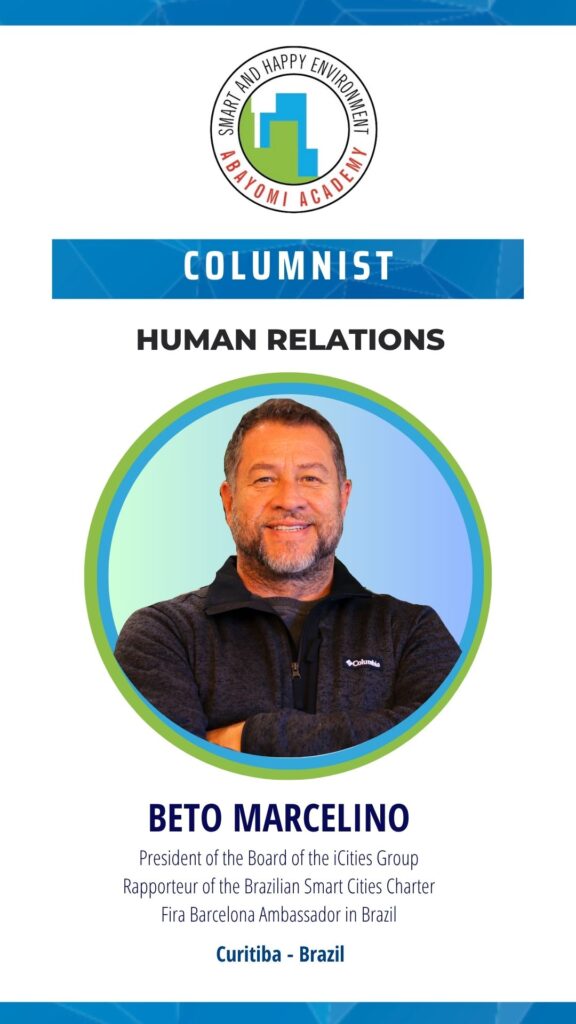
Beto Marcelino serves as Chairman of the Board for iCities Group and is the co-founder of the Brazilian holding company, a benchmark in the urban innovation and smart cities ecosystem. As a pioneering agent in this field, he was one of the rapporteurs for the Brazilian Charter of Smart Cities, an initiative by the Ministry of Cities, and also participated in the Cities 4.0 program, from the Ministry of Science, Technology, and Innovations (MCTI), contributing to the construction of the National Policy for Smart Cities.
He holds a degree in Agronomic Engineering from the Federal University of Paraná (UFPR), with a specialization in smart cities from Smart City Expert, and an MBA in Marketing from FAE Business School. He is also an ambassador for Fira Barcelona in Brazil, strengthening the connection between global events and the Brazilian urban context.
Social Media:
Instagram: Instagram Instagram
LinkedIn: Beto Marcelino

Beto Marcelino serves as Chairman of the Board for iCities Group. He is the co-founder of the Brazilian holding company, a benchmark in the urban innovation and smart cities ecosystem. As a pioneering agent in this field, he was one of the rapporteurs for the Brazilian Charter of Smart Cities, an initiative by the Ministry of Cities, and also participated in the Cities 4.0 program, from the Ministry of Science, Technology, and Innovations (MCTI), contributing to the construction of the National Policy for Smart Cities.
He holds a degree in Agronomic Engineering from the Federal University of Paraná (UFPR), with a specialization in smart cities from Smart City Expert, and an MBA in Marketing from FAE Business School. He is also an ambassador for Fira Barcelona in Brazil, strengthening the connection between global events and the Brazilian urban context.