By Regina Cohen
ABSTRACT
Cities are universally recognized as paradigms for democracy, and their physical design should provide accessibility for all – understood as the elimination of all physical and social barriers for people with disabilities and reduced mobility. Universality and sustainability should direct the design of all buildings and urban spaces, and a research from the schools of architecture, design, engineering, social sciences, etc.
Initiated with the support of the university’s president, this project addressed the relationship between city, built environment, and accessibility, through the fundamental concepts of sustainable development and universal design. We are particularly interested in:
a) The study and development of architectural and urban design solutions and guidelines for the environment; and
b) The implementation, testing, and evaluation of these solutions and guidelines in the City of Rio de Janeiro.
RESEARCH PROBLEM
The City of Rio de Janeiro suffers from a two-fold set of problems. On one side, distances are enormous, open spaces are various and carry many barriers, and landscaping is almost non-existent: neither the city master plan nor its day-to-day management considers the needs of individuals and groups carrying disabilities. On the other side, building materials are inappropriate, design solutions are excluding, and technological improvement is ignored: in the Brazilian public context of severe economic limitations, sustainability and universal design should always be considered as fundamentals for project development.
Because this project seeks the betterment of the quality of life of people with disabilities and – because of its sustainability and universality – of every user of the city, its results and recommendations will serve as a demonstration project and will certainly contribute toward a change of mentality in Brazilian society.
PROPOSAL
This project addresses how the lack of care in spatial and architectural design affects individuals and disability groups when utilizing facilities in the City of Rio de Janeiro, a situation which may ultimately result in social segregation, learning, and competence problems.
Because of the wide range of disabilities, at the initial stage, the research only focused on people with walking and mobility disabilities, that is: wheelchair users, pregnant women, obese and elderly persons, etc. It is expected that these studies will result in a series of design solutions and recommendations that will help adapt the city toward sustainable development and universal design.
To attain this purpose, the project pursued the following objectives:
- to study the use of the city space, behavioral and cognitive manifestations by those individuals and groups with walking and mobility disabilities;
- to evaluate the impacts that spatial and physical barriers have upon urban performance and inter-personal relationships;
- to generate design solutions and guidelines for the urban planning of the city for sustainable development and universal design;
- to contribute toward awarding design professionals and the public at large of the importance of such a built environment for the quality of life;
- to contribute to the creation of new and more humane architecture and urban design paradigms.
METHODOLOGY
The plan for this project research includes the following major steps:
Step 1: Definition of Theoretical Framework
Identify state-of-the-art, major concepts and theories on sustainable development, accessibility, universal design, and urban design, concluding on the ideal relationships between them.
Step 1: Case-Study – The City of Rio de Janeiro
Study the development of the city, and the spatial, physical and social aspects of the master plan. Definition and application of field research methods and techniques for the study of cognition and behavior patterns, with emphasis on individuals and groups with disabilities. Study on prejudice and their real integration to urban life and to the society.
Step 1: Interpretation of Data, Design Guidelines, and Recommendations
Systematic and integrated analysis of all data obtained, with special attention to spatial and physical categories. Develop a multi-criteria system for design guidelines and recommendations for architectural and urban design in general.
Stage 4: Conceptual Re-Design of the Master Plan for the City of Rio de Janeiro
Development of preliminary plans and schematic design solutions for the adaptation of the existing master plan, taking into account time-frame, cost and other applicability limitations.
ANALYSIS
A self-sustainable, responsive and universal built-environment is the major benefit that may result from the implementation of this project. In the case of the City of Rio de Janeiro, mobility would be truly democratic as all individuals will have a barrier-free access to all spaces.
On the verge of a new century, society is living a time of intense changes, including great scientific, technological and cultural advances, which resulted mostly from efforts, creativity and competence of urban institutions.
However, a city does not brew a mere professional: it must educate a true citizen. The construction of a better world and a higher quality of life depend on ideological principles such as equality, diversity, and liberty with solidarity, all coincident with the paradigm of sustainable development and universal design.
The citizens of Rio will be the major beneficiaries of this project, as it will permit a better understanding of the various spatial and physical problems that afflict individuals and groups with disabilities. The eventual implementation of the design recommendations may decrease health hazards and lead to solving social conflicts, group discrimination, and learning disabilities.
The implementation of this project may serve as a “demonstration project” for the city and country as a whole, so that a more humane built environment may result. Two are the major reasons why the results of this project will probably obtain wide public visibility. Firstly, the City of Rio de Janeiro is one of the more important touristic cities in Brazil and several of its spaces are recognized among the most beautiful in the country.
The development of such a project and the implementation of its recommendations will most certainly influence and inspire other cities. Secondly, Rio de Janeiro is experiencing a very particular moment in terms of local and national politics. In fighting the bad image, the loss of identity, the lack of neighborhood self-esteem, and the low quality of life, for the past couple of years, the city government has implemented various major urban design projects. In this sense, the public realm is serving as an important testing of different streetscapes, infrastructur,e and furniture design solutions by different architects through a series of public competitions.
CONCLUSIONS
Checking the existents and our own strategies, we intend to adopt new perspectives in the urban and architectural planning, contributing to a real sustainable development. With our conclusions, we’ll be fomenting the awareness that persons with mobility difficult spatial and temporal experiences will only be concrete and positive when transformed into action possibilities.
So, the main focus of the project is the contribution for the space understanding. This space will exist on its complete form, when it is, above everything, lived and utilized by all the groups of the Brazilian society, including the persons with disability and mobility difficult, on the realization of their many everyday life activities.
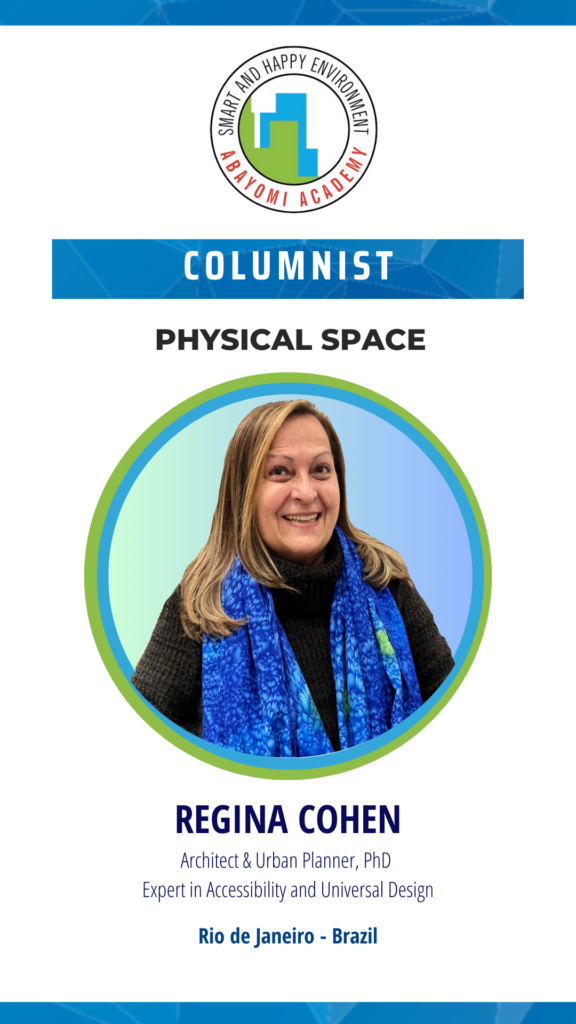
Architect, Abayomi Academy Member, G3ict/Smart Cities for All Country Representative for Brazil, CPABE (Certified Professional in Accessible Built Environments), International Accessibility Consultant, Associated researcher and specialist on accessibility. Award from the United Nations Forum Zero Project. In 2014, she was a Visiting Assistant Professor at the Disability Studies Center of Syracuse University (FULBRIGHT/CAPES). Master’s degree in Urbanism at Federal University of Rio de Janeiro UFRJ (2000), PhD in Psycho-sociology of Communities at UFRJ (2006), Post-Doctoral Degree (2013) (FAPERJ, UFRJ). Regina coordinated the Pro-access group at UFRJ. Member of Municipal Council of Persons with Disability in RJ (COMDEF RIO). Was Coordinator of the Rio de Janeiro State Accessibility Commission of the Architecture Council (CAU RJ, 2018-2020, 2024-2026) and member of the City of Rio de Janeiro Council (2024). Cohen was a Member of the Forum UFRJ Accessible. Worked in the Project “Accessibility for the Brazilian World Cup 2014” (CNPq), in the Accessibility Manual of the Paralympic Games – RIO 2016, and was alsoa Consultant of Accessibility for the Conference of Sustainability RIO+20. EAAE INTERNATIONAL PRIZE 2001-2002 – Writings in Architecture Education – Best Architecture Education Methodology of the world, co-authored with Cristiane Rose Duarte. Many other awards for scientific projects realized, published studies on accessibility for persons with disability.