By Vanessa Canever
In many companies, leaders are appointed because they stood out in operational work, and leadership is still supported by rigid hierarchical structures. We believe that, to build truly strong teams, we must adopt a systemic view that sees the organization as a living organism—just like our body, made of interdependent organs and cells. Through this parallel, we can see that each “part” must function in harmony to generate high-impact results.
In our body, each organ has a specific function, but it’s the coordination between them that sustains life. If the liver is overloaded, the entire organism shows signs of stress. We can draw this analogy with a company: it is not just a collection of departments—it is a living being that breathes processes, metabolizes information, and grows through people.
In a Segmented View, each area looks after its own “territory” without realizing the impact on others. In an Integrated View, all areas understand how their actions affect the whole and prioritize the health of the complete “organism.” If we want to maintain organizational health, it is not enough to look at isolated metrics—we must observe systemic indicators such as climate, engagement, quality of deliverables, and innovation. And any intervention, such as training, hiring, or process change, only truly works if aligned with a complete diagnosis.
The first point is to rethink: what is the role of leadership? If the answer is merely to ensure everything runs “correctly,” the leader is just an organizer of tasks, leaving no room for autonomy or innovation. If leadership means enhancing results, the leader becomes an orchestrator of people—someone who draws out the best in each individual. A good leader believes in and sees another’s potential even more than they do themselves. And this leads to the second factor: for the team to be strong, it must be treated and regarded as strong. Some aspects influence this: direction, communication, culture, and trust.
Without direction, team members become mere automatic task executors. A clear purpose is like the nervous system of the organism—it connects each action to the destination we want to reach. If a leader thinks, “I work with adults, I’ve already given the direction, I don’t need to repeat it,” it means they are not giving due importance to this point. Traveling on a road, we face many crossroads—at each one, we need clarity about our destination; otherwise, it’s easy to get lost and end up elsewhere. The same happens in a company: there are many setbacks, unforeseen events, and opportunities that arise, and it’s not just one person who can drift off course, but several, and the result can fall far short of expectations.
Direction is given through good communication. Just as neurons transmit impulses to coordinate movements, process information, and respond quickly to stimuli, communication transmits “impulses” between people or teams to align actions, correct mistakes, and generate new responses. Communication has many nuances: it can be direct and objective, or more careful and detail-rich. It can be informative, corrective, motivating, celebratory, or aimed at creating moments of relaxation. The more it is present in companies with this focus, the greater the team’s synergy will be. Gossip, controversial topics, and complaints without improvement purposes should be avoided.
Feedback and feedforward make a big difference in building strong teams. The first refers to evaluating the past; the second to a future perspective. While feedback realigns the route, feedforward helps us go further. They can be formal, in pre-scheduled moments, or spontaneous along the way. Ideally, both should happen for individual and collective growth.
Culture is the DNA that guides our behaviors and decisions. It is born from the beliefs we share, the rituals we practice, and the stories that reinforce our purpose. To strengthen our culture, we need to document principles in a simple, visual format, live these values daily, and correct quickly when something goes off track. A good culture brings a sense of belonging and engagement.
For talent to flourish, we need fertile soil—an environment of trust, where people feel psychologically safe. They can speak up without fear of retaliation. They can suggest, give feedback, propose improvements, and innovate. They know mistakes are part of the process and will be welcomed. Everyone has room to contribute.
In Potenciologia, we believe that recognizing, using, and amplifying human potential is the way to keep this “organism” alive and strong. We help managers identify the best place for a person to perform their activities, the work style in which they have the most flow, and how to develop their talents. We also help them improve management skills by enhancing direction and communication, implementing or strengthening culture, and building healthy environments.
When we apply these tools, we transform the organization into a living system where each person, process, and area works in synergy. This way, we build strong and sustainable teams, capable of thriving even in challenging scenarios.
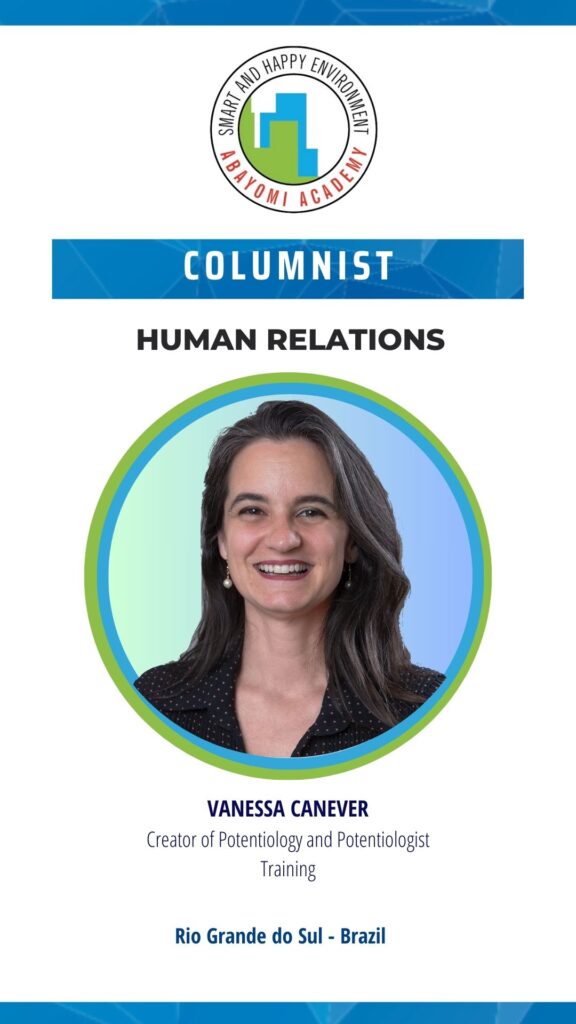
Creator of Potentiology and Potentiologist Training. Master’s Degree in Education. Postgraduate in people management, business pedagogy, group dynamics, and distance learning. Specialist in Emotional Intelligence and agile methods. Works with human potential and the development of people so that they can achieve better results, in the shortest possible time, and in a light way.
Get to know more about Vanessa and the Potenciology.