By Alessandro Lopes
For centuries, humanity has tried to understand itself through languages, silences, and invisible codes. Yet what we now call intelligent communication is not a modern invention; it was born when the first drums spoke for those who could not. Each beat was a sentence, each pause a gesture of resistance. The drums were the first binary code of the diáspora, zeros and ones in ancestral vibration, translating pain into belonging.
While the West was inventing machines to think, Black people had already created other ways of listening — hearing with the body, the rhythm, and the gaze. True intelligence has always been collective. It built quilombos, rebuilt families, re-created languages, and reimagined what it means to be connected. Long before algorithms, there existed an invisible thread linking voices that recognized one another amid the noise, the same thread that today tries to reconnect a fragmented humanity.
Intelligent communication does not live in devices but in relationships. It happens when technology learns to serve life, and not the other way around. When innovation becomes ethics, when words turn into bridges instead of walls. When a digital platform becomes a terreiro, a sacred space of dialogue and repair, where knowledge meets, memory rebuilds itself, and affection translates into gestures of care.
Speaking is not enough; we must listen to what pulses beneath the words. We must listen to the planet, to people, to silences. The Earth also communicates, though we often fail to understand her language. Climate change, data wars, and digital inequality are messages we still refuse to hear — signs that we have not yet learned to listen to one another, nor to the world we inhabit.
In creative cities and global networks, communication is more than information; it is the weaving of belonging and shared responsibility. Every voice, even the silenced one, is an essential data point for understanding the whole. Every narrative is a key to unlocking history’s quiet places. Words, when used wisely, are instruments of justice. They can correct centuries of exclusion, retell erased stories, and rebuild bridges across continents. But to do so, they must cease to be tools of power and return to being expressions of humanity.
Perhaps this is the deepest lesson of the digital diaspora. The networks that truly matter are not made of cables and satellites, but of people bound by empathy and purpose. The future of communication lies not in machines that answer quickly, but in people who know how to wait, to listen, to welcome. Between the drum and the keyboard lies a continuity, the enduring desire to be understood, to keep alive the spark of encounter, to create shared meaning in a world scattered into fragments.
As the drums vibrate beneath the concrete and screens flicker in our hands, one question echoes across borders, languages, and centuries:
Are we truly communicating as humanity — or merely transmitting signals across a planet that is becoming deaf to itself?
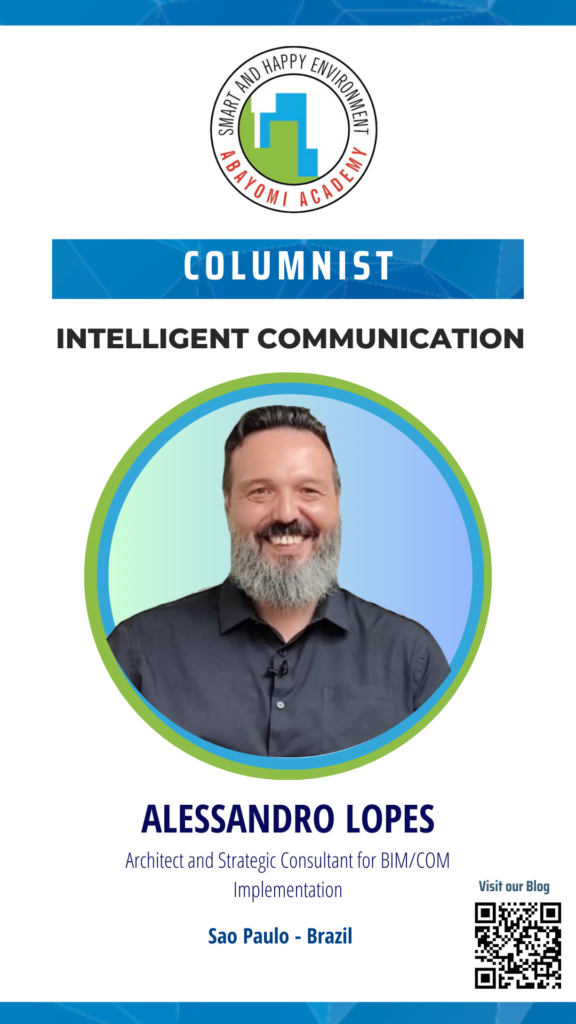
Alessandro Lopes is an architect and consultant in BIM/CIM and Smart Cities, with a master’s degree in Environmental Law from UNISANTOS, focusing on Creative and Sustainable Cities. He serves as an Advisor at the Municipality of Santos, leading urban revitalization and sustainability projects, and as Coordinator of the Architecture and Urbanism Program at ESAMC Santos, bridging education, market, and innovation. A specialist in project management and sustainability, he is a CBIM member, speaker, and commentator on radio and podcasts about innovation in civil construction. His key contributions include the modernization of Santos’ waterfront and the restructuring of the public administration’s quality and control sector.
Get to know more about him: Facebook. Instagram. LinkedIn