By Beto Marcelino, Chairman of the Board at iCities Group
For years, we talked about smart cities as a concept of the future. They are now an imperative. And at the center of this transformation is data, not just as an asset, but as the driving force behind faster, more human, and more effective decisions.
The era of big data has brought us an abundance of information. But we now face the real challenge: turning this massive amount of content into practical wisdom, applied to the everyday life of cities and their citizens. The data collected from sensors, systems, and platforms must be translated into more effective public policies, more efficient services, and above all, elevated life quality. This has been iCities’ mission since its founding: to put technology at the service of those who live in cities, from north to south across Brazil.
I see this every day in conversations with public administrators, entrepreneurs, academics, and citizens. Assaí, located in Paraná’s countryside, for example, has become a benchmark in innovation and was recently named one of the world’s seven smartest communities, joining the ranks of Curitiba and cities like Coral Gables (USA), Durham (Canada), Fredericton (Canada), Hilliard (USA,) and Yunlin (Taiwan). Initiatives such as “Assaí Tech” and the creation of the “Vale do Sol Innovation Agency,” designed to foster research and collaboration to improve public sector efficiency, demonstrate just how essential smart governance and strong investments in education are to building a future with a better quality of life for residents. Modernization and digital transformation need the right support to thrive, and they directly impact the progress and development of our cities.
But the current cycle isn’t just about efficiency. It’s about integration. The connected industry, powered by the Internet of Things (IoT), artificial intelligence, 5G networks, interoperability, and urban platforms, is already transforming entire value chains — from mobility to public health. In São Paulo, for example, a network of smart traffic lights adjusts pedestrian crossing times for seniors, using automatic card reading. In Recife, drones collect data in high-risk areas to support disaster prevention plans. When data becomes a decision, cities become more responsive to quality of life, because they are shaped by data-driven choices with real, measurable impact.
It is with this vision that we are preparing for the second edition of the IoT Solutions Congress Brasil 2025, which takes place in September. The event will serve as a strategic space for connecting companies, startups, tech leaders, and decision-makers. Its agenda is focused on practical solutions that boost productivity, reduce costs, and open up new business opportunities across various economic sectors.
Digital transformation is no longer a promise of the future: it’s a present-day necessity. Organizations that succeed in extracting real value from data will lead the way, just as governments that seize this opportunity to innovate will shape the future. The future of industry and society lies in connected intelligence, strategic automation, and the ability to make increasingly informed, agile, and sustainable decisions.
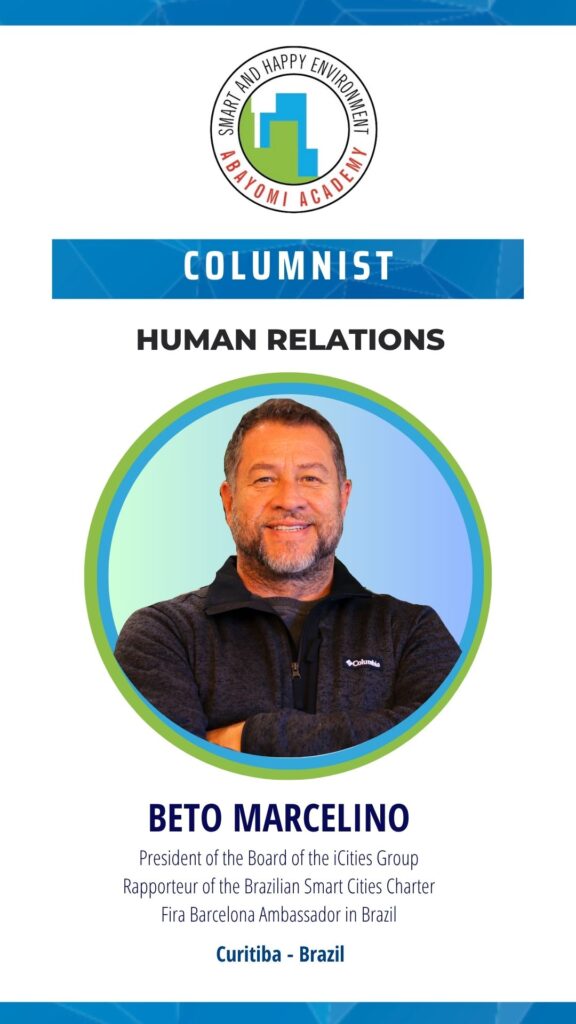
Beto Marcelino serves as Chairman of the Board for iCities Group and is the co-founder of the Brazilian holding company, a benchmark in the urban innovation and smart cities ecosystem. As a pioneering agent in this field, he was one of the rapporteurs for the Brazilian Charter of Smart Cities, an initiative by the Ministry of Cities, and also participated in the Cities 4.0 program, from the Ministry of Science, Technology and Innovations (MCTI), contributing to the construction of the National Policy for Smart Cities.
He holds a degree in Agronomic Engineering from the Federal University of Paraná (UFPR), with a specialization in smart cities from Smart City Expert, and an MBA in Marketing from FAE Business School. He is also an ambassador for Fira Barcelona in Brazil, strengthening the connection between global events and the Brazilian urban context.
Social Media:
Instagram: Instagram Instagram
LinkedIn: Beto Marcelino

Beto Marcelino serves as Chairman of the Board for iCities Group. He is the co-founder of the Brazilian holding company, a benchmark in the urban innovation and smart cities ecosystem. As a pioneering agent in this field, he was one of the rapporteurs for the Brazilian Charter of Smart Cities, an initiative by the Ministry of Cities, and also participated in the Cities 4.0 program, from the Ministry of Science, Technology, and Innovations (MCTI), contributing to the construction of the National Policy for Smart Cities.
He holds a degree in Agronomic Engineering from the Federal University of Paraná (UFPR), with a specialization in smart cities from Smart City Expert, and an MBA in Marketing from FAE Business School. He is also an ambassador for Fira Barcelona in Brazil, strengthening the connection between global events and the Brazilian urban context.