By Gabriela Moreira
ESG has become fashionable – and like any fashion, it runs the risk of being superficial. But those who understand its true potential are light years ahead in the sustainability game. After all, ESG is not a trend. It’s a language of the future. And like any language, it requires practice, understanding, and experience to have an impact.
In recent years, this acronym has become one of the most repeated in corporate circles, board meetings, and institutional marketing plans. But between repeating and practicing, there is an ocean. The good news? Companies that are crossing this ocean with strategic courage are already reaping the rewards. The bad news? Those who only talk the talk tend to fall behind – and fast.
Where does ESG come fro,m and where is it going?
The term ESG originated in 2004 by a report by the UN Global Compact in partnership with the World Bank (“Who Cares Wins”), proposing that environmental, social and governance issues should be considered by investors as part of their analysis of the risk and value of companies. Since then, this perspective has evolved from a recommendation to a market requirement.
Today, investors, consumers, and regulators are paying attention to who adopts ESG practices – and, more than that, who integrates them coherently into the organizational culture and performance indicators.
In other words, ESG is not about looking good. It’s about doing it well. It’s about turning risk into opportunity and purpose into competitive advantage.
When ESG gets off the drawing board and generates value
Recent studies have shown that companies with good ESG practices tend to have:
- Higher market valuation (some as much as 25% higher, according to data from PwC and BCG),
- Lower cost of capital,
- Reduced operational, reputational, and legal risks, and
- Greater ability to attract talent and conscious consumers.
A notable example is Natura, which has consolidated its leadership in Latin America not only through the quality of its products but through the way it integrates environmental and social indicators throughout the value chain. Another example is Patagonia, which redefines profit as a tool for reinvesting in solutions to the climate crisis.
But ESG isn’t just for giants. Startups, cooperatives, small businesses, and even local governments are learning that being ESG isn’t about having a certification – it’s about having a management model that is intelligent, transparent, and coherent with the challenges of the 21st century.
ESG in practice: where to start?
The strategic application of ESG involves a few key steps:
- Honest diagnosis: Where is your organization in the environmental, social, and governance pillars? What is being done? What is missing? What already exists and can be strengthened?
- Clear targets and indicators: there’s no point in promising zero carbon by 2050 without short-term targets. The path is made up of measurable steps.
- Transparency and communication: stakeholders need to know where you are and where you’re going. ESG reports and public commitments reinforce credibility.
- Organizational culture: ESG is not an isolated sector. It needs to be in HR, purchasing, operations, leadership, and the grassroots.
- Constant updating: environmental legislation, social demands, and good practices are evolving. ESG is dynamic.
The role of the environmental professional
This is where we come into our own. As environmental professionals, we are bridges between technique and strategy. We are the ones who translate data into decisions, who bring innovation into public and private management, and who ensure that sustainability is at the center – and not the margin – of processes.
Environmental management, combined with an ESG vision, gains strength, relevance, and purpose. And this strength is multiplied when we understand that environmental innovation is also management innovation.
Where are we going?
ESG is the foundation. But every foundation needs pillars. And one of the most important of these is the circular economy, a topic we’ll cover next month. If ESG shows what needs to be done, the circular economy shows how to do it – with intelligence, reuse, and process redesign.
Until then, here’s an invitation: how about reviewing today how your personal and institutional actions can go beyond words and generate real impact?
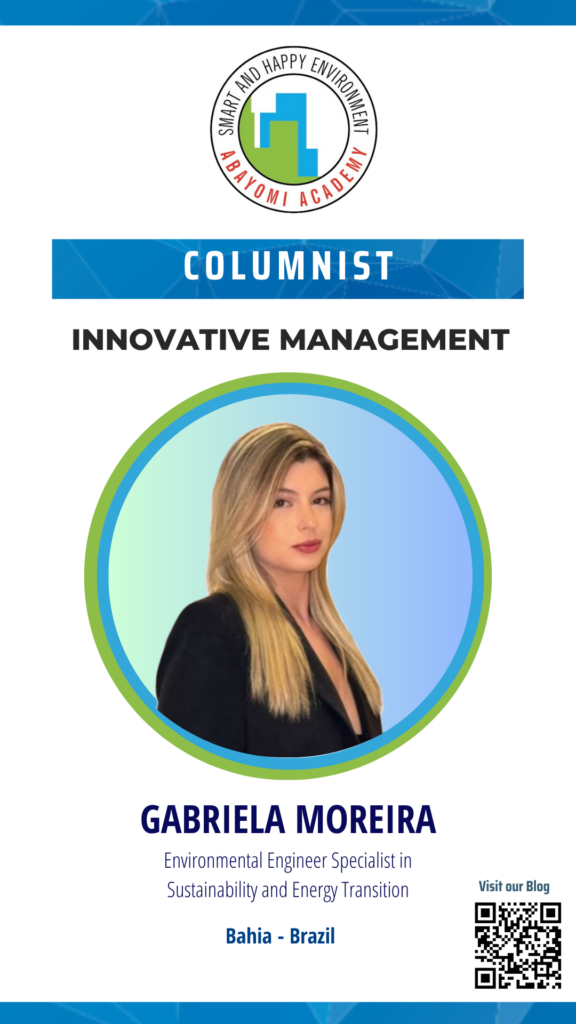
Gabriela Moreira is an environmental engineer specializing in sustainability and energy transition. With a focus on innovative decarbonization strategies, she is dedicated to addressing the challenges of the transition to sustainable energy sources. Her approach stands out for proposing creative and effective solutions to global environmental issues, as well as exploring the opportunities generated by the adoption of cleaner energy.