Big data, AI, and intelligent monitoring at the service of sustainability.
By Gabriela Moreira
The climate crisis requires a rapid, intelligent, and scalable response. In this scenario, the digitalization of environmental management has emerged as a game changer. Technologies such as Big Data, Artificial Intelligence (AI), and connected sensors are already being successfully applied in environmental monitoring, risk prediction, and natural resource optimization projects. More than a trend, this is an ongoing revolution.
What is the digitalization of environmental management?
Digitizing environmental management means transforming environmental data, which was previously scattered and difficult to access, into strategic information and automated actions. This involves
- Real-time collection by sensors (Internet of Things – IoT);
- Massive data analysis (Big Data);
- Predictive modeling with AI;
- Integrated decision-making platforms.
Big Data: the power of massive data
The use of Big Data makes it possible to process colossal volumes of data on air quality, water, soil, biodiversity, and emissions. Instead of sporadic sampling, we now have continuous streams of information that reveal patterns, anticipate impacts, and accurately inform public policies.
Take, for example, the project of a Brazilian environmental consultancy. In partnership with an American multinational company, the project uses Big Data to predict pollution levels in Chinese cities up to 72 hours in advance, optimizing mitigation measures and environmental impacts.

AI in environmental prediction and decision-making
AI algorithms have been used to detect leaks in supply networks, predict forest fires based on weather patterns, and to analyze satellite images and identify illegal deforestation.
One very inspiring case is the Brazilian startup Ambipar Response. The company has developed an AI that crosses chemical and meteorological variables to detect imminent environmental risks in industrial plants, increasing safety and reducing damage.
Smart monitoring: sensors and connectivity in the field
Sensors connected via IoT offer real-time monitoring of variables such as water pH, soil quality, GHG emissions, and environmental noise. This allows for immediate corrective action and complete traceability.
For example, in sustainable agricultural plantations. The sensors indicate the ideal time for irrigation, avoiding waste, reducing costs, and protecting groundwater.
Challenges and ethical precautions
Despite the enormous potential, the digitalization of environmental management requires attention to the protection of sensitive data, democratization of access to technologies and digital infrastructure, and technical training for environmental professionals to interpret and operate digital systems.
Brazil: strategic opportunity
With its vast biodiversity, territorial extension, and privileged location, Brazil’s environmental role has everything it takes to lead this digital revolution. We depend mainly on
Investments in technology and research;
Partnerships between government, universities, and the private sector;
Creation of public policies that encourage the use of digital tools in environmental licensing, inspection, and reporting.
The digitalization of environmental management is no longer optional. It redefines the role of the environmental professional, who now acts more strategically, analytically, and interconnected with other areas of science and technology.
Adopting digital tools not only improves efficiency but also increases transparency, traceability, and the ability to respond to increasingly complex environmental challenges. In the next article, climate justice and social innovation will be addressed. Find out why a truly sustainable transition needs to look to the margins, include diverse voices, and transform social realities from slums to forests.
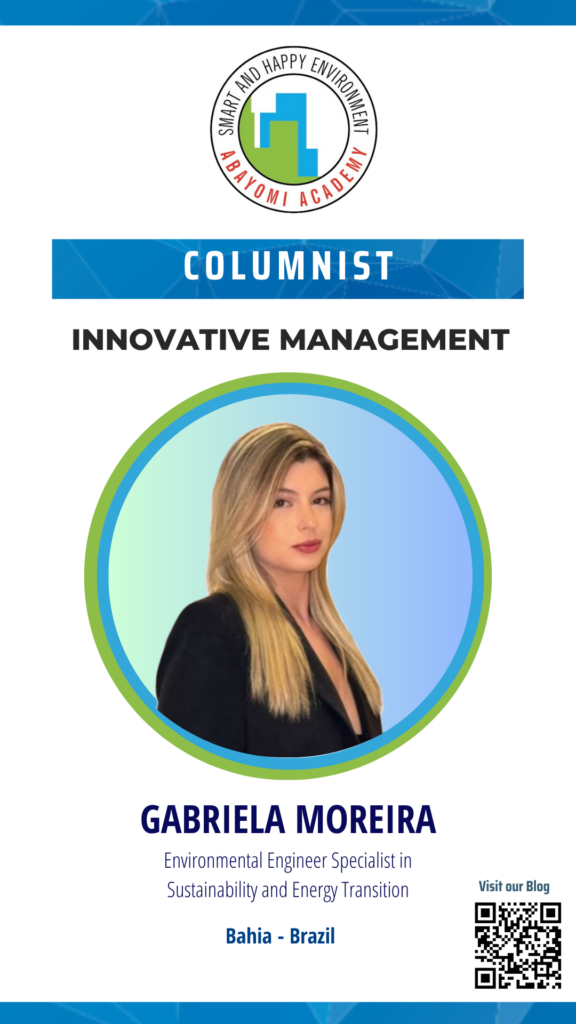
Gabriela Moreira is an environmental engineer specializing in sustainability and energy transition. With a focus on innovative decarbonization strategies, she is dedicated to addressing the challenges of the transition to sustainable energy sources. Her approach stands out for proposing creative and effective solutions to global environmental issues, as well as exploring the opportunities generated by the adoption of cleaner energy.