By Dr. Lamiaa Adel Shaheen
When we talk about empowerment, especially women’s empowerment, we often focus on education, leadership, and representation. Yet one critical element remains largely overlooked in these conversations: the power of physical space. As an Assistant Professor of Architecture and a researcher in spatial design, I’ve come to believe that how we shape space, in turn, shapes how people feel, function, and flourish, particularly women and marginalized groups.

Physical space isn’t just a passive backdrop to human activity. It’s an active player. It influences how we move, speak, learn, rest, and even think. Everything from the classroom layout to the ceiling height or the availability of natural light can promote confidence and creativity or subtly discourage full participation.
For women in learning or professional environments, this is especially true. A poorly designed space, with harsh lighting, limited privacy, or rigid seating, sends a message: You must adapt to the space, even if the space does not serve you. But a space that is flexible, inclusive, and thoughtfully designed tells a different story: You belong here, and your comfort matters.
In one of my recent teaching experiences, I worked with a team of students to redesign a common lounge on campus. We removed hard, linear seating and replaced it with warm textures, movable furniture, and plants to introduce natural softness. We introduced adjustable lighting to accommodate both focused work and relaxed conversation. The feedback was striking, students, especially women, described feeling more “at ease,” “welcomed,” and even “motivated” to stay longer in that environment.
This is what I call designing with dignity. It is the idea that we are not simply designing for function, but for humanity. A dignified space allows for vulnerability and voice. It acknowledges that the user is not just a body passing through, but a person deserving of care, empowerment, and agency.
In architecture education and practice, we often celebrate form, style, and innovation. But it’s time to also celebrate empathy in design. As female designers, we carry a unique lens often grounded in lived experience when considering how a space impacts emotional well-being. That perspective is not only valid; it’s vital.
We must also challenge the industry norm that beauty and comfort are mutually exclusive, or that efficiency always trumps user experience. The truth is, the most powerful spaces are those that integrate form, function, and feeling.
Empowering women through space means:
- Designing restrooms and lactation rooms that are accessible and dignified.
- Creating classroom layouts where every student feels seen and heard.
- Incorporating quiet areas, wellness corners, and inclusive wayfinding for people of all identities.
These design choices aren’t expensive, they’re intentional.
And the impact goes beyond the physical. When women are in environments that affirm their presence, they are more likely to speak up, lead, innovate, and inspire others. That is how spatial equity fuels social equity.
So next time you step into a space, whether a school, office, gallery, or café, pause and ask:
Who was this space designed for? And who might be left out?
Let us, as designers, educators, and change-makers, create spaces that answer, “For everyone. Especially those who were once left behind.”
Because space speaks. And what it says can change lives.

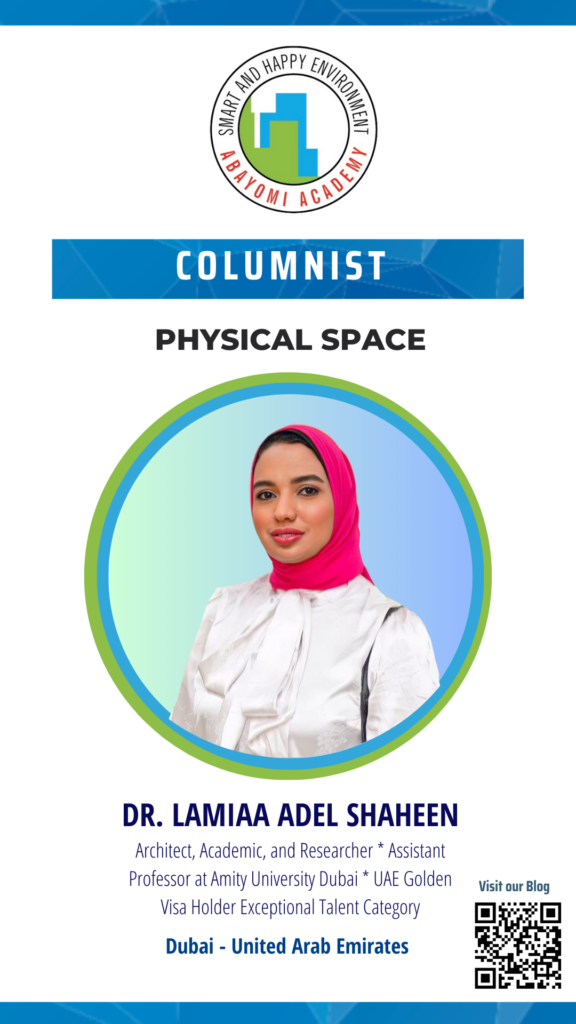
Dr. Lamiaa Adel Shaheen is an accomplished Architect, Academic, and Researcher. Her expertise in the field has been recognized internationally, as evidenced by her prestigious UAE Golden Visa in the “Qualified professionals and Exceptional Talents” Category also recognized as Columnist 2024 Abayomi Academy, and Ambassador of Quality of Life UAE 2024, got 2nd place in the Abayomi Academy international Award for Physical space category 2024. With a Ph.D. in Architecture, she has dedicated her career to pushing the boundaries of Design and Innovation. Currently, Dr. Lamiaa serves as an Assistant Professor at Amity University Dubai, specializing in the Architecture and Interior Design Department. With a Focus on Sustainable Design and Human-Centric Spaces, Dr. Lamiaa continues to make a significant impact in the world of Architecture and Interior Design.
Get to know more about her: LinkedIn