By Beto Marcelino, chairman of the board at iCities
In my previous article, I invited readers to dive into the concept of the blue economy as a promise of a sustainable future for Brazil: a future that begins now, in the way we produce, consume, regulate, and protect our oceans. Today, I want to dive deeper into these concepts because, beyond the (necessary) fascination of imagining a prosperous ocean-based nation, there is a question that changes everything: is the blue economy solely an inspiring concept or is it an economic model capable of moving millions and impacting the lives of thousands of people?
For me, the answer is clear: the blue economy is already both an inspiration and an economic engine. It inspires because it repositions the ocean as a fundamental part of our economy, not merely as a beautiful landscape or a place for leisure. It is an engine because it already drives entire value chains, creates jobs, guides investments, and accelerates innovation in energy, logistics, tourism, fisheries, aquaculture, biotechnology, and environmental services. When we talk about an ocean-based Brazil, we are also talking about people: the workers whose livelihoods depend on the sea, the researchers who transform knowledge into data and smart solutions, the entrepreneurs who find value in the ocean and its resources, and the public managers who understand that development and conservation must always go hand in hand.
There is, however, a decisive detail: economic models only become sustainable when they turn into a collective agenda. That is why promoting events focused on this theme is so strategic. Platforms for dialogue centered on the ocean economy are not mere “ceremonies”; they are spaces of convergence. They are where the scientific community, governments, companies, investors, universities, and civil society sit at the same table to debate ideas and turn them into projects, partnerships, public policies, and concrete opportunities. It is there that priorities align and where discourse gains the strength needed to leave paper and come to life.
I like to say that these gatherings are seeds. A seed is small and makes no noise when it falls to the ground, but it carries an entire future within it. These events help disseminate learning: cities and organizations exchange lessons learned, what failed, what has the potential to be replicated, and what should be avoided. In the end, the seed becomes an ecosystem. This year, during the event Tomorrow Blue Economy, held in Niterói in late November, we saw many young people attending panels and roundtable discussions, which offer a powerful glimpse into the future of the oceans. After all, the earlier young people are present in debates about the future, the sooner they will take on a leading role in developing solutions.
There is also a very tangible impact felt by the host cities of these events: the legacy. A gathering focused on the blue economy leaves positive traces that remain long after the exhibitions and debates have ended. Institutional connections, ongoing structural and scalable projects, capacity-building initiatives, international visibility, and a sense of identity linked to the sea endure, and alongside this, the perception of the waterfront as a living space grows stronger: a territory where health, well-being, and a sense of belonging meet new opportunities. When the ocean gains prominence on a city’s agenda, the waterfront strengthens its role as a platform for active mobility, leisure, and events that energize the local economy: from seaside runs and walks to open-water crossings, rowing competitions, music shows, art events, and other experiences that connect people to the ocean in positive ways. The city becomes recognized as a hub of innovation and sustainability, attracting talent, strengthening tourism, and driving initiatives in infrastructure, education, and coastal governance. It is a transformation that begins on the calendar but ends in urban planning, the local economy, and the community agenda.
In this sense, the UNESCO Ocean Decade agenda is a powerful example of how to align ambition with action. The initiative brings together global efforts related to ocean science and consistently directs them toward real-world challenges, from climate adaptation to biodiversity, from pollution to food security. Connecting an event to this agenda strengthens its purpose and relevance. It is not merely about “talking about the ocean economy,” but about contributing to a global movement that fosters cooperation, innovation, and measurable, intelligent solutions. This is precisely where Tomorrow Blue Economy Niterói fits in: as part of a broader mobilization that places Brazil on the map of contemporary responses to the future of the oceans, as an official action of the Ocean Decade.
What I would also like to advocate for is a posture of continuity: events cannot stand alone. Each edition should expand networks, deepen commitments, monitor results, and generate new agreements. When a city hosts an event of this nature, it also assumes the role of a living laboratory. Niterói has become a territory under observation, where what was discussed has the potential to turn into prototypes, pilot projects, public policies, programs, and practices.
If we want to honestly answer the question that opens this article, whether the blue economy is an inspiration or an economic model, we must recognize that there is room for it to be both. Brazil has a coastline, biodiversity, knowledge, highly qualified researchers, entrepreneurs, and a historic opportunity to be among the leaders. I hope that intention and theory turn into action, and that this movement becomes reality, always striving for a more sustainable, human-centred,d and intelligent economy, one that coexists with the oceans in a relationship of respect and mutual cooperation.
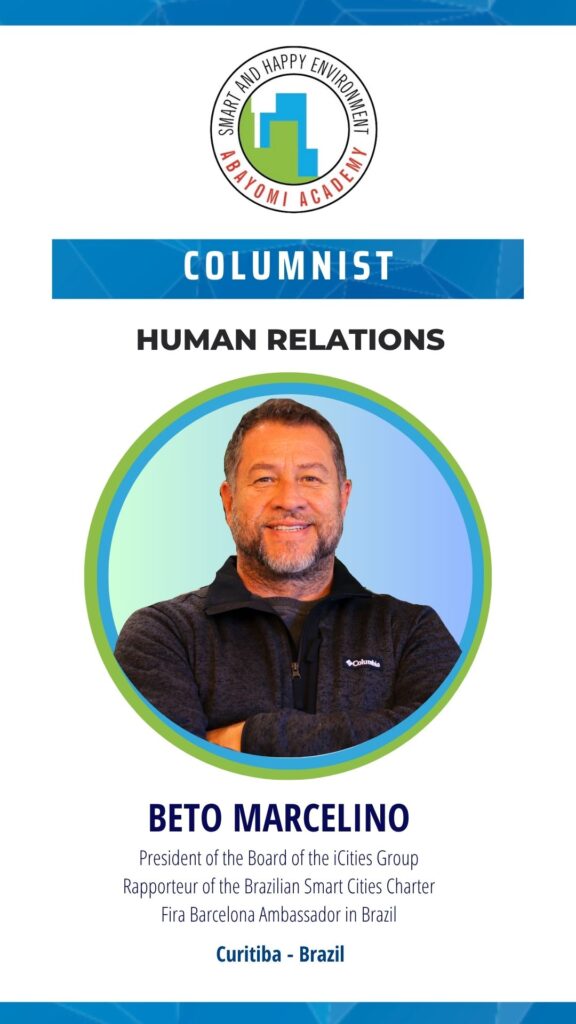
Beto Marcelino serves as Chairman of the Board for iCities Group and is the co-founder of the Brazilian holding company, a benchmark in the urban innovation and smart cities ecosystem. As a pioneering agent in this field, he was one of the rapporteurs for the Brazilian Charter of Smart Cities, an initiative by the Ministry of Cities, and also participated in the Cities 4.0 program, from the Ministry of Science, Technology, and Innovations (MCTI), contributing to the construction of the National Policy for Smart Cities.
He holds a degree in Agronomic Engineering from the Federal University of Paraná (UFPR), with a specialization in smart cities from Smart City Expert, and an MBA in Marketing from FAE Business School. He is also an ambassador for Fira Barcelona in Brazil, strengthening the connection between global events and the Brazilian urban context.
Social Media:
Instagram: Instagram Instagram
LinkedIn: Beto Marcelino