Designing More Humane, Resilient, and Happier Cities for All Ages
By Regina Cohen
- INTRODUCTION
ARCHITECTURE, ACCESSIBILITY, AND LONGEVITY
This article addresses population aging as one of the main contemporary challenges of urban planning. It highlights the need for inclusive cities capable of ensuring accessibility, autonomy, and quality of life throughout the entire life cycle. The text articulates the concepts of architecture, accessibility, and longevity as inseparable elements in the construction of more humane, resilient, and socially just environments. It also emphasizes that accessibility should be understood as a strategy for longevity, going beyond mere regulatory compliance, and underscores the role of universal design and the concept of ageing in place in promoting active and healthy aging.
The increase in life expectancy and the accelerated process of population aging impose new challenges on contemporary cities. In this context, it becomes essential to rethink the urban environment to ensure accessibility, autonomy, and quality of life for people of all ages. Designing inclusive urban spaces is a fundamental condition for promoting healthy longevity, especially for older adults and people with reduced mobility.
The significant growth of the elderly population, observed worldwide and particularly in Brazil, requires a profound review of urban planning strategies. In Brazil, for example, the population is aging rapidly: by 2050, more than 30% of the population will be elderly. This reality presents challenges and opportunities in areas such as preventive healthcare and rehabilitation; adapted housing; accessible transportation; digital and social inclusion; and lifelong education.
This transformation demands effective public policies, accessible infrastructure, and services capable of meeting the needs of different age groups, considering the functional diversity present throughout life.
Architecture, accessibility, and longevity constitute an inseparable triad in the construction of more humane, resilient, happy, and socially just cities and buildings. Architecture can be understood as the means by which space is transformed into experience, anticipating needs, welcoming different bodies, and accompanying the changes inherent to aging. Accessibility, in turn, goes beyond simple compliance with technical standards, such as ABNT NBR 9050, and assumes the role of ensuring safety, autonomy, and dignity for all people, with or without disabilities, at any stage of life.
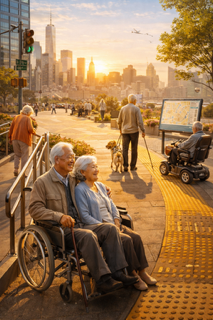
In this sense, accessibility must be understood not as an exception, but as an essential strategy for longevity. Accessible environments promote independence, safety, and well-being, while also contributing to active and healthy aging. Universal design establishes the bridge between accessibility and longevity by proposing the creation of spaces designed for everyone from the outset—featuring clear circulation, accessible communication, and environmental comfort—thus consolidating a more inclusive and sustainable urban approach.
Longevity reflects not only the increase in life expectancy but also the expansion of functional diversity over time. Designing for longevity means conceiving adaptable, flexible, and durable spaces capable of aging alongside their users. When these three principles are integrated, environments emerge that are inclusive by design, prepared for population aging, and socially and economically sustainable — safer, more comfortable, and more welcoming for all.
Despite progress, significant challenges remain in the construction of truly inclusive cities, such as budget constraints, gaps in enforcement, cultural barriers, and a lack of information or a concrete understanding of standards. Even so, longevity represents a strategic opportunity to innovate in public policies, strengthen social engagement, and promote healthier and more equitable accessible urban environments that ensure independence and safety for all, including older adults.
- ACCESSIBILITY AND LONGEVITY: Designing Cities for All Ages
Accessibility refers to the guarantee that all people can fully participate in social life, regardless of age, disability, or any temporary or permanent limitation. Its central objective is to eliminate barriers and promote autonomy, safety, and dignity for all citizens.
This concept encompasses different dimensions, including:
2.1 Accessibility
Accessible physical environments, such as ramps, handrails, adapted elevators, accessible restrooms, tactile signage, as well as sidewalks and transportation systems that allow safe and independent mobility.
Accessible technology, including websites compatible with screen readers, video captions, adequate visual contrast, and voice commands, ensures digital inclusion.
Inclusive communication, based on the use of plain language, sign language, audio description, and braille materials, expands access to information.
2.2 Longevity
Longevity concerns the increase in life expectancy combined with the pursuit of quality throughout aging. In Brazil, population aging is occurring at an accelerated pace, with projections indicating that by 2050, more than 30% of the population will be elderly.
This scenario imposes challenges and creates opportunities in several areas, such as healthcare prevention and rehabilitation, adapted housing, accessible transportation systems, digital and social inclusion, and lifelong education.
2.3 The Relationship Between Accessibility and Longevity
With advancing age, accessibility ceases to be a demand restricted to specific groups and becomes a universal necessity. Even people without disabilities may, over time, experience physical, sensory, or cognitive limitations that affect their interaction with the urban environment.
In this sense, designing with accessibility means planning for longevity. Accessible environments contribute to independence, safety, and active aging among the elderly population, while also benefiting society. Likewise, public policies focused on accessibility play a fundamental role in promoting fairer and happier cities.
The concept of universal design—understood as the creation of spaces, products, and services designed for everyone from the initial conception—establishes the main bridge between accessibility and longevity, consolidating itself as a strategic axis for sustainable urban development.
- ACCESSIBILITY AND LONGEVITY IN ARCHITECTURE
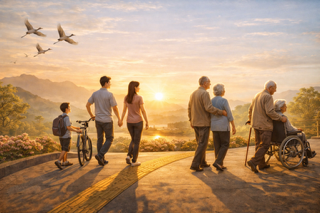
In architecture, accessibility and longevity are associated with the design of spaces capable of serving people throughout different stages of life. Given population aging, it becomes essential to develop inclusive projects that consider users’ diverse physical, sensory, and cognitive capacities.
Accessible architecture aims to eliminate barriers and promote autonomy, safety, and comfort, while longevity in architecture relates to the principles of universal design, proposing environments usable by all, regardless of age or physical condition, without the need for future adaptations. This includes wide circulation areas, properly sloped ramps, non-slip flooring, efficient lighting, adapted bathrooms, well-defined contrasts, tactile and visual signage, and ergonomic furniture.
In this context, architecture moves beyond responding solely to immediate demands and begins to incorporate a long-term vision, contributing to well-being, independence, and quality of life throughout the entire lifespan.
“Architecture also ages. And the bodies that use it, even more so. Most spaces are designed for young, agile bodies without limitations. But the demographic reality is different. Aging brings predictable changes: reduced strength, decreased balance, sensory alterations, and increased risk of falls. Ignoring this in design is not neutral. It produces silent exclusion.
This is not ‘architecture for the elderly.’ It is architecture that continues to function as time passes. Humanized architecture is architecture that accompanies the entire life course.”
WhatsApp Group of the 2nd International Congress on Humanized Architecture
- COMPLIANCE WITH ABNT NBR 9050 AND THE PRINCIPLES OF UNIVERSAL DESIGN
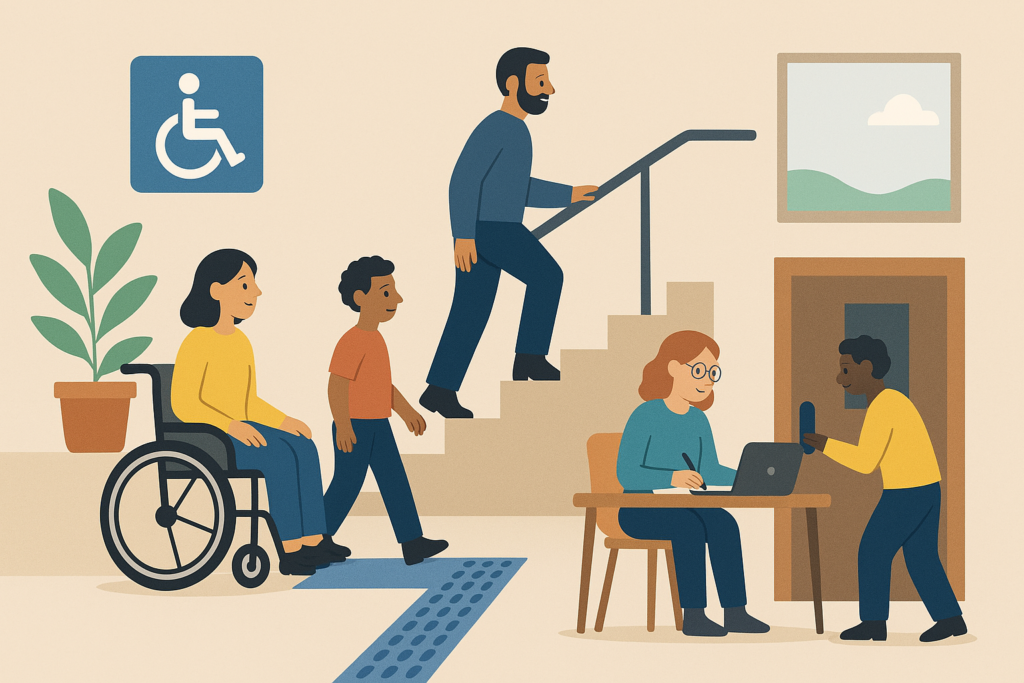
In accordance with the ABNT Accessibility Technical Standard (NBR 9050) and the principles of Universal Design, architectural projects focused on accessibility and longevity must ensure inclusive, safe, and efficient conditions of use for the greatest possible number of users.
In this context, design should promote equitable use of spaces, ensuring dignified access without segregation; incorporate flexibility of use to meet different profiles and needs; and adopt simple and intuitive solutions that facilitate understanding and spatial orientation.
Additionally, information must be perceptible through appropriate visual, tactile, and auditory communication resources; environments should minimize risks and misuse, ensuring tolerance for error; and enable low physical effort, favoring user comfort and autonomy.
Finally, the dimensions and spaces required for circulation, approach, and use must be respected, meeting regulatory requirements and diverse mobility conditions, including wheelchair users, people with reduced mobility, older adults, and companions.
- PRINCIPLES OF URBAN ACCESSIBILITY
Universal Mobility: planning urban infrastructure that ensures safe and autonomous movement, including adequate sidewalks, ramps, accessible signage, and inclusive public transportation.
Inclusive Public Spaces: development of public areas that promote coexistence and equitable use by people of different ages and conditions, with appropriate urban furniture and infrastructure.
Adequate Housing: encouragement of accessible housing production, incorporating architectural solutions that ensure comfort, safety, and functionality.
Assistive Technology: integration of technological resources that expand accessibility and facilitate access to information and urban mobility.
- BENEFITS OF AN ACCESSIBLE CITY
Cities that invest in accessibility promote social inclusion, autonomy, and quality of life. Adequate urban environments contribute to reducing accidents, strengthening intergenerational interaction, and expanding access to essential services such as healthcare, education, and leisure.
Best Practices in Urban Accessibility
Initiatives such as reserved parking spaces for older adults, free public transportation, sidewalk requalification programs, and adherence to international certifications focused on active aging demonstrate cities’ commitment to accessibility and equity in the use of urban spaces. Among numerous examples are the Age-Friendly Cities initiative by the World Health Organization (WHO) and the Safe Sidewalk Program.
- TECHNICAL SYNTHESIS
The integrated application of NBR 9050 and Universal Design principles results in safer, more adaptable, and inclusive environments capable of accompanying human diversity over time with dignity and autonomy, going far beyond mere compliance with a technical standard.
Architecture, Accessibility, and Longevity
The integration of architecture, accessibility, and longevity is fundamental to ensuring quality throughout all stages of life. Accessible architectural projects favor mobility, comfort, and safety, especially in the context of population aging.
Architecture oriented toward longevity prioritizes durable, flexible, and functional solutions that adapt to changes over time. When these concepts are articulated, spaces become more inclusive, future-ready, and socially sustainable. Ramps, wide corridors, elevators, and adequate signage are essential elements when designing spaces that meet the needs of a population that is living longer.
The design of cities and residences should also value solutions such as non-slip flooring, efficient lighting, and safe social areas, welcoming different bodies and providing comfort for all, accompanying life’s changes, and transforming space into experience.
- CONCLUSIONS
As an architect, I understand that accessibility must be conceived as a strategy for longevity, not as an exception, but as a guarantee of autonomy, safety, happiness, and dignity for all people—with or without disabilities, at any age. Architecture plays a central role in materializing this vision by transforming principles into built environments that are more humane, safe, and resilient.
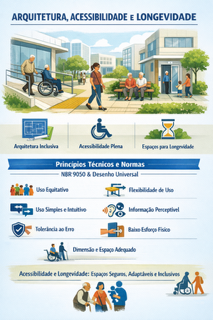
In summary:
Architecture: spaces that welcome and adapt to life’s transformations.
Accessibility: autonomy, safety, and dignity from the project’s inception.
Longevity: environments prepared for aging and functional diversity.
Designing accessible cities, urban spaces, and architecture for all ages is a commitment to social development in the present and the future, promoting inclusion, civic participation, and quality of life for the entire population.